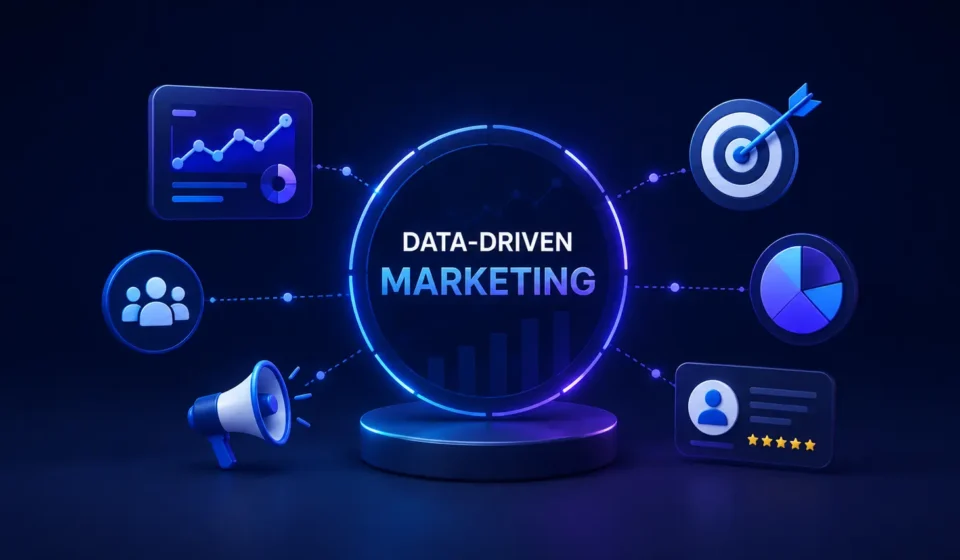

In today’s digital world, businesses no longer rely on guesswork to attract customers. Instead, they use data-driven marketing to understand customer behavior, improve campaigns, and make smarter business decisions.
Whether you’re a startup, an e-commerce store, or a large enterprise, using data effectively can help you reach the right audience, increase sales, and maximize your marketing budget.
In this guide, you’ll learn what data-driven marketing is, how it works, its benefits, and how artificial intelligence is transforming modern marketing strategies.
What Is Data-Driven Marketing?
Data-driven marketing is the process of using customer data, analytics, and insights to plan, execute, and optimize marketing campaigns.
Instead of making decisions based on assumptions, marketers use real information such as:
- Website traffic
- Customer demographics
- Purchase history
- Social media engagement
- Search behavior
- Email performance
- Advertising metrics
This information helps businesses understand what customers want and how to deliver the right message at the right time.
Simply put, data-driven marketing uses facts instead of guesses to improve marketing performance.
Why Is Data-Driven Marketing Important?
Modern consumers interact with brands across multiple platforms, including websites, social media, mobile apps, and email.
Without data, it becomes difficult to understand customer preferences.
Data-driven marketing helps businesses:
- Understand customer behavior
- Create personalized experiences
- Improve conversion rates
- Increase return on investment (ROI)
- Reduce unnecessary marketing costs
- Make faster and smarter decisions
Companies that use data effectively often achieve better marketing results than those relying solely on traditional methods.
How Does Data-Driven Marketing Work?
The process generally involves five simple steps:
1. Collect Data
Businesses gather information from various sources:
- Google Analytics
- CRM software
- Social media platforms
- Website forms
- Email campaigns
- Online purchases
2. Analyze the Data
Marketing teams analyze the collected information to identify trends and customer behavior patterns.
For example:
- Which pages receive the most traffic?
- Which products sell the most?
- Which advertisements generate the highest conversions?
3. Create a Marketing Strategy
Based on the insights, businesses create a data-driven marketing strategy that targets the right audience with relevant content and offers.
4. Launch Campaigns
The strategy is implemented through:
- SEO
- Social media marketing
- Google Ads
- Email marketing
- Content marketing
- Paid advertising
5. Measure and Improve
After launching campaigns, marketers continuously monitor performance and make improvements based on new data.
This ongoing optimization is one of the biggest strengths of data-driven marketing.
Data-Driven Marketing Strategy
A successful data-driven marketing strategy focuses on understanding customer needs rather than simply promoting products.
Some important components include:
Audience Segmentation
Group customers based on:
- Age
- Gender
- Location
- Interests
- Purchase history
- Online behavior
This allows businesses to deliver personalized messages.
Customer Journey Analysis
Understanding each stage of the customer journey helps improve engagement.
Typical stages include:
- Awareness
- Consideration
- Decision
- Purchase
- Loyalty
Marketing campaigns should be optimized for each stage.
Performance Tracking
Every campaign should be measured using metrics like:
- Website traffic
- Click-through rate (CTR)
- Conversion rate
- Cost per acquisition (CPA)
- Customer lifetime value (CLV)
These insights help improve future campaigns.
Data-Driven Marketing with Artificial Intelligence
One of the biggest trends today is data-driven marketing with artificial intelligence (AI).
AI enables marketers to analyze massive amounts of data within seconds and make accurate predictions.
Artificial intelligence can help with:
- Customer segmentation
- Product recommendations
- Content creation
- Chatbots
- Email personalization
- Predictive analytics
- Ad optimization
For example, streaming platforms recommend movies based on viewing history, while online shopping websites suggest products based on previous purchases.
AI makes marketing smarter, faster, and more personalized.
Data-Driven Performance Marketing
Data-driven performance marketing focuses on measurable results rather than assumptions.
Every advertising campaign is tracked and optimized based on actual performance data.
Common performance metrics include:
- Return on Ad Spend (ROAS)
- Conversion Rate
- Cost Per Click (CPC)
- Cost Per Lead (CPL)
- Return on Investment (ROI)
By analyzing these metrics, businesses can invest more in successful campaigns and improve underperforming ones.
Data-Driven Online Marketing
The growth of digital platforms has made data-driven online marketing more important than ever.
Businesses collect online data through:
- Website visitors
- Search engines
- Social media platforms
- Mobile apps
- Online advertisements
- Email newsletters
Using this information, companies can deliver highly targeted campaigns that reach the right audience at the right time.
This improves engagement while reducing marketing costs.
Benefits of Data-Driven Marketing
Using data provides several advantages.
Better Customer Understanding
Businesses gain valuable insights into customer preferences and behavior.
Improved Personalization: Customers receive relevant content, recommendations, and offers based on their interests.
Higher ROI: Marketing budgets are spent more efficiently because campaigns target the right audience.
Faster Decision Making: Real-time analytics help marketers respond quickly to changing customer behavior.
Better Customer Experience: Personalized interactions increase customer satisfaction and loyalty.
Popular Tools for Data-Driven Marketing
Many businesses use specialized tools to collect and analyze marketing data.
Popular platforms include:
- Google Analytics
- Google Search Console
- HubSpot
- Salesforce
- SEMrush
- Ahrefs
- Meta Business Suite
- Microsoft Clarity
- Hotjar
- Looker Studio
These tools help marketers make informed decisions using real data.
Challenges of Data-Driven Marketing
Although data-driven marketing offers many benefits, it also presents some challenges.
Common issues include:
- Poor data quality
- Data privacy regulations
- Information overload
- Complex analytics
- Integration across multiple platforms
Businesses should ensure that collected data is accurate, secure, and used responsibly.
Future of Data-Driven Marketing
The future of marketing will become even more data-focused.
Emerging trends include:
- AI-powered automation
- Predictive marketing
- Voice search analytics
- Hyper-personalization
- Customer journey mapping
- Real-time campaign optimization
Companies that embrace these technologies will be better positioned to compete in the digital marketplace.
Best Practices for Data-Driven Marketing
To get the best results:
- Set clear marketing goals.
- Collect high-quality data.
- Understand your audience.
- Use AI and automation where appropriate.
- Continuously monitor campaign performance.
- Optimize strategies based on analytics.
- Respect customer privacy and data protection laws.
Small improvements based on data can produce significant long-term growth.
Conclusion
Data-driven marketing has become one of the most powerful approaches in modern digital marketing. By using customer data and analytics, businesses can make informed decisions, improve campaign performance, and deliver more personalized experiences.
Whether you’re implementing a data-driven marketing strategy, exploring data-driven marketing with artificial intelligence, improving data-driven performance marketing, or strengthening your data-driven online marketing efforts, the key is to let data guide every marketing decision.
In a competitive digital landscape, businesses that understand and use data effectively will be better equipped to attract customers, build stronger relationships, and achieve long-term success.
FAQs
Businesses use various types of data, including website traffic, customer demographics, purchase history, email engagement, social media interactions, search behavior, and campaign performance metrics to understand their audience and optimize marketing efforts.
Popular tools include Google Analytics 4 (GA4), Google Search Console, Looker Studio, Meta Ads Manager, Google Ads, customer relationship management (CRM) platforms, and marketing automation tools. These help businesses collect, analyze, and visualize marketing data.
Beginners should start by defining clear marketing goals, setting up analytics tools, tracking key performance indicators (KPIs), understanding customer behavior, and using the collected data to improve future marketing campaigns. Regular analysis and testing are essential for long-term success.