
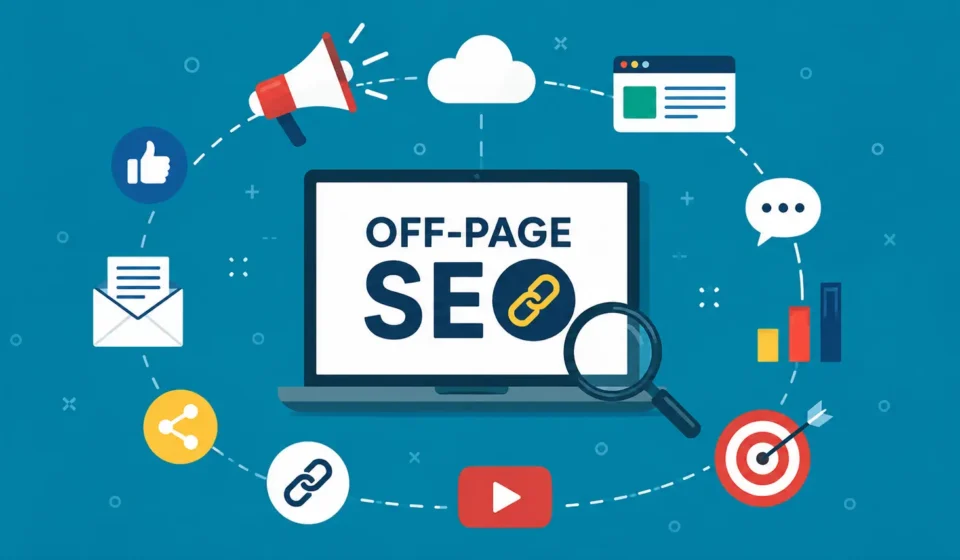

When people think about SEO, they often focus on optimizing content, keywords, and website speed. However, SEO doesn’t end after publishing a webpage. To improve your website’s authority and search engine rankings, you also need Off-Page SEO.
Off-Page SEO refers to all the activities performed outside your website to improve its trust, authority, and visibility in search engines like Google, Bing, and AI-powered search platforms.
Simply put, Off-Page SEO tells search engines how trustworthy and valuable your website is based on what other websites and people say about it.
What Is the Importance of Off-Page SEO?
Many beginners ask, “Does Off-Page SEO matter for search engine rankings?”
The answer is Yes.
Google uses hundreds of ranking factors, and many of them are related to your website’s reputation on the internet.
Importance of Off-Page SEO
- Builds website authority
- Increases search engine rankings
- Generates high-quality backlinks
- Improves brand awareness
- Drives referral traffic
- Increases trust and credibility
- Helps pages get indexed faster
- Supports long-term SEO growth
Even if your content is excellent, it may not rank well if your website lacks authority.
Difference Between On-Page and Off-Page SEO
Many beginners confuse these two SEO types./
| On-Page SEO | Off-Page SEO |
| Optimizes your website | Optimizes your website’s reputatio |
| Keywords | Backlinks |
| Meta Tags | Brand Mentions |
| Internal Linking | Guest Posting |
| Content Optimization | Digital PR |
| Technical SEO | Social Signals |
| Controlled by you | Mostly influenced by others |
Both are equally important for a successful SEO strategy.
How to Do Off-Page SEO
If you’re wondering How to do Off-Page SEO, start with these proven strategies.
1. Build High-Quality Backlinks
Backlinks are links from other websites pointing to your website.
Google considers backlinks as recommendations.
However, quality matters more than quantity.
Good Backlinks
- Relevant websites
- Trusted websites
- High-authority domains
- Natural editorial links
Avoid buying backlinks or participating in link schemes, as these can violate Google’s guidelines.
2. Guest Blogging
Guest blogging means writing articles for other websites in your industry.
Benefits include:
- High-quality backlinks
- Brand exposure
- Referral traffic
- Networking opportunities
Always contribute valuable and original content rather than writing solely for backlinks.
3. Brand Mentions
Search engines can recognize mentions of your brand even without a clickable link.
For example,
“Odiva.blog published a helpful SEO guide.”
This brand mention helps build your online reputation.
4. Social Media Marketing
Although social media links are generally “nofollow,” sharing your content on platforms like Facebook, Instagram, LinkedIn, X, and YouTube can:
- Increase visibility
- Drive website traffic
- Encourage backlinks
- Improve brand awareness
Great content often earns natural links when shared widely.
5. Content Marketing
Publishing useful content naturally attracts backlinks.
Examples include:
- Research articles
- Ultimate guides
- Infographics
- Case studies
- Statistics
- Free tools
- Checklists
The more useful your content is, the more likely others will reference it.
6. Local SEO Citations
For local businesses, citations are important.
A citation includes:
- Business Name
- Address
- Phone Number (NAP)
Ensure your information is consistent across directories and your Google Business Profile.
7. Online Reviews
Customer reviews help both users and search engines.
Encourage genuine reviews on platforms like:
- Google Business Profile
- Industry-specific directories
Positive reviews improve trust and local visibility.
8. Influencer Collaboration
Working with industry experts or creators can help:
- Increase brand awareness
- Earn backlinks
- Generate referral traffic
- Reach new audiences
Choose collaborators relevant to your niche.
9. Community Participation
Participate in online communities by answering questions and sharing expertise.
Examples include:
- Quora
- Industry forums
- LinkedIn Groups
Focus on providing value rather than promoting your website.
10. Digital PR
Digital PR involves earning media coverage through:
- Press releases
- Original research
- Surveys
- Industry reports
- Newsworthy content
Mentions from reputable publications strengthen your site’s authority.
Off-Page SEO Activities List
Here are some common Off-Page SEO activities:
| Activity | SEO Benefit |
| Link Building | Improves authority |
| Guest Posting | Earns quality backlinks |
| Digital PR | Builds trust |
| Social Media Promotion | Increases visibility |
| Brand Mentions | Strengthens authority |
| Local Citations | Improves local SEO |
| Online Reviews | Builds credibility |
| Influencer Outreach | Expands reach |
| Content Marketing | Attracts natural backlinks |
| Forum Participation | Increases visibility |
| Broken Link Building | Earns relevant backlinks |
| Podcast & Webinar Participation | Improves brand recognition |
What Are the Most Effective Off-Page SEO Strategies for a New E-commerce Website?
A new e-commerce website often has limited authority. These strategies can help build trust and visibility over time:
- Create buying guides and product comparison articles.
- Earn backlinks from industry blogs and review websites.
- Optimize your Google Business Profile if you have a physical store.
- Encourage genuine customer reviews.
- Collaborate with influencers in your niche.
- Promote products through social media.
- Build relationships with suppliers and partners who may link to your website.
- Publish helpful content that answers customer questions.
Focus on long-term trust rather than quick wins.
Does Off-Page SEO Matter for Search Engine Rankings?
Yes. Off-Page SEO remains one of the strongest signals of website authority.
Search engines evaluate:
- Backlink quality
- Brand mentions
- Content relevance
- Website reputation
- User trust
- Industry authority
Strong Off-Page SEO supports higher rankings, especially in competitive niches.
Best Tools for Off-Page SEO Analysis
These tools help monitor backlinks, authority, and competitor performance.
| Tool | Purpose |
| Google Search Console | Monitor backlinks and indexing |
| Ahrefs | Backlink analysis and competitor research |
| Semrush | Off-page SEO audits and link tracking |
| Moz Link Explorer | Domain Authority and backlink analysis |
| Screaming Frog | Internal and external link analysis |
| Google Alerts | Track brand mentions |
| BuzzSumo | Find popular content and influencers |
Common Off-Page SEO Mistakes
Avoid these mistakes:
- Buying backlinks
- Participating in link exchange schemes
- Creating backlinks from irrelevant websites
- Ignoring brand mentions
- Posting duplicate guest articles
- Building too many low-quality directory links
- Focusing only on quantity instead of quality
- Neglecting online reviews and reputation management
Off-Page SEO Best Practices
Follow these best practices to build long-term authority:
- Earn backlinks naturally through valuable content.
- Build relationships within your industry.
- Focus on high-quality, relevant websites.
- Keep your business information consistent across directories.
- Encourage authentic customer reviews.
- Monitor your backlink profile regularly.
- Create content that others genuinely want to reference.
- Avoid shortcuts that violate Google’s spam policies.
Is Link Building Still Important in 2026?
Yes, but the focus has shifted from link quantity to link quality and relevance.
Modern search engines also consider:
- Brand authority
- Entity-based signals
- Topical relevance
- User engagement
- E-E-A-T (Experience, Expertise, Authoritativeness, and Trustworthiness)
The best links are those earned because your content is useful—not because you asked or paid for them.
Conclusion
Off-Page SEO is essential for improving your website’s authority, credibility, and visibility in search results. While On-Page SEO helps search engines understand your content, Off-Page SEO shows why your website deserves to be trusted. By earning quality backlinks, building your brand, encouraging reviews, engaging with your audience, and creating valuable content, you can strengthen your online presence and achieve sustainable rankings. Remember that Off-Page SEO is a long-term strategy—consistent effort and genuine value will produce better results than shortcuts.
FAQs
Off-Page SEO includes all optimization activities performed outside your website to improve authority, trust, and search engine rankings. Common examples include backlinks, brand mentions, digital PR, and social media promotion.
Off-Page SEO helps search engines evaluate your website’s reputation and credibility. Strong off-page signals can improve rankings, increase referral traffic, and strengthen your brand.
Start by creating valuable content, earning high-quality backlinks, optimizing your Google Business Profile, participating in industry communities, and building genuine relationships with other websites.
While social media links are not usually direct ranking factors, they help increase content visibility, drive traffic, build brand awareness, and create opportunities to earn natural backlinks.
Yes. Strong brand authority, trusted backlinks, topical expertise, and high-quality mentions help improve visibility not only in traditional search engines but also in AI-powered search experiences.



[…] Off-Page SEO […]
[…] Off-page SEO(Backlink) […]