
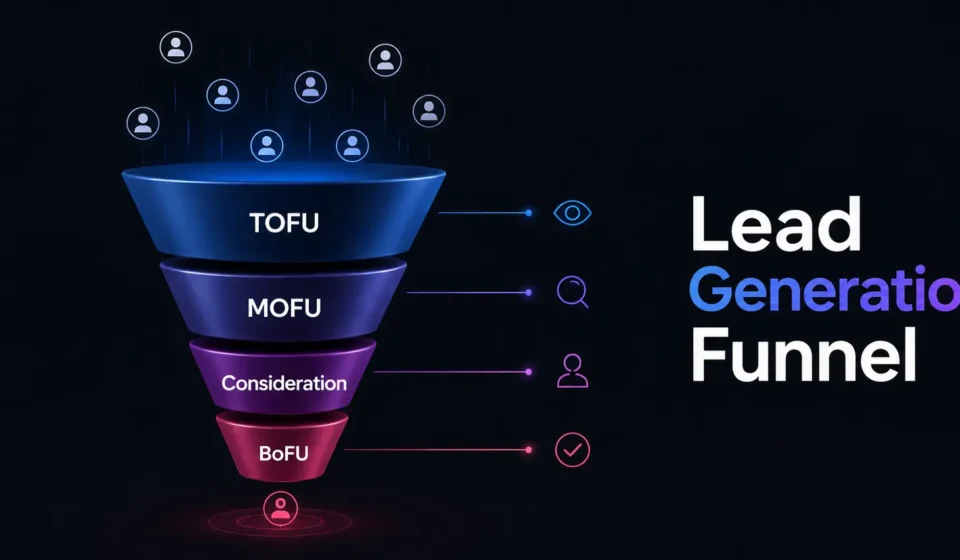

A lead generation funnel is a structured process that shows how a person moves from discovering your business to becoming a customer.
It begins when someone first hears about your brand and ends when they take action—like buying a product, booking a call, or contacting your team. In simple terms, a lead generation funnel helps you attract people, build interest, gain trust, and convert them into leads or customers.
Why Is a Lead Generation Funnel Important?
A well-defined funnel helps businesses:
- Reach the right audience
- Educate users instead of forcing sales
- Build long-term trust
- Improve conversion rates
- Track marketing performance clearly
Without a funnel, marketing efforts can feel scattered and less effective.
Key Lead Generation Funnel Stages
Understanding the key lead generation funnel stages helps you guide potential customers smoothly at every step.
1. Awareness Stage (Top of Funnel – ToFu)
This is where the journey begins. At this stage, people:
- Discover your brand for the first time
- Search for information or solutions
- Consume content like blogs, videos, social media posts, or ads
Goal: Attract attention and create visibility.
Example:
A user searches “how to generate online leads” and finds your blog post.
2. Interest / Capture Stage (Middle of Funnel – MoFu)
Once users know about you, the next step is engagement.
At this stage, you:
- Offer valuable content such as ebooks, webinars, checklists, or templates
- Use landing pages with forms to collect contact details
- Exchange value for information (this is called a lead magnet)
Goal: Capture leads by providing useful and relevant content.
3. Consideration / Prospecting Stage
Now the user is a lead and wants to learn more.
At this stage, you:
- Send helpful email sequences
- Share case studies, tips, or success stories
- Educate leads about how your solution can help them
Goal: Build trust and position your brand as the right choice.
4. Decision Stage (Bottom of Funnel – BoFu)
This is the final and most important stage.
Here, leads are ready to take action:
- Book a consultation
- Request a product demo
- Start a free trial
- Make a purchase
A strong call to action (CTA) makes this step clear and easy.
Goal: Convert interested leads into customers.
Simple Example of a Lead Generation Funnel
- User reads a blog (Awareness)
- User downloads a free guide (Interest / Capture)
- User receives helpful emails (Consideration)
- User books a demo or buys a service (Decision)
Conclusion:
A lead generation funnel is not about selling immediately. It’s about guiding people step by step with the right message at the right time.
By understanding the key lead generation funnel stages, businesses can:
- Attract quality leads
- Build trust naturally
- Increase conversions
Achieve sustainable growth

I appreciate the breakdown of the funnel stages—seeing how awareness transitions to conversion really highlights the importance of targeted content at each step. It also makes it clear why tailoring strategies for each stage can significantly improve overall lead generation effectiveness.