
Quick Summary
Generative AI and Agentic AI serve different purposes but complement each other. While Generative AI creates content like text and code, Agentic AI plans, decides, and completes complex workflows. Understanding their differences, use cases, benefits, and future trends helps businesses and software engineers choose the right AI solution.
Have you ever wondered why some AI tools simply generate content while others can plan tasks and complete entire workflows on their own? The answer lies in the difference between Generative AI and Agentic AI. As Artificial Intelligence (AI) continues to transform industries, understanding Generative AI vs Agentic AI has become essential for developers, businesses, and technology enthusiasts. While Generative AI creates text, images, videos, and code, Agentic AI can make decisions, use software tools, and execute complex tasks with minimal human intervention. This guide explains how these technologies work, their key differences, real-world applications, benefits, challenges, and future trends.
What is Artificial Intelligence?
Artificial Intelligence, commonly called AI, is a branch of computer science that focuses on building machines capable of performing tasks that normally require human intelligence.
These tasks include understanding language, recognizing images, solving problems, making decisions, learning from experience, and answering questions. AI systems improve their performance by analyzing large amounts of data and identifying useful patterns.
Simple examples of AI in daily life
From smartphones to online shopping, AI quietly powers many of the digital services we use every day.
| Example | How AI helps |
| Virtual assistant | Answers questions like weather, reminders, or directions |
| Shopping websites | Suggests products based on your searches and purchases |
| Streaming apps | Recommends movies, songs, or shows you may like |
| Email filters | Detects spam and unwanted messages |
Artificial Intelligence is now used in healthcare, education, banking, transportation, manufacturing, entertainment, and software development. As technology continues to improve, AI is becoming an important part of everyday life.
Evolution of AI
Artificial Intelligence has developed over several decades. It has moved from simple rule-based systems to advanced models that can understand language and solve complex tasks.
Main stages of AI development
Artificial Intelligence has evolved through several major stages, with each stage making AI smarter and more capable than before.
| Stage | What it did | Why it mattered |
| Rule-based AI | Followed fixed instructions written by programmers | Solved simple problems |
| Machine Learning | Learned from data instead of only fixed rules | Improved accuracy over time |
| Deep Learning | Used neural networks inspired by the human brain | Improved speech, image, and language tasks |
| Large Language Models | Understood and generated natural language | Helped with writing, coding, and Q&A |
| Agentic AI | Planned, reasoned, and completed tasks more independently | Took AI beyond content generation |
What changed over time?
The following are important factors:
- Early AI systems were limited and rigid.
- Machine Learning helped computers learn from examples.
- Deep Learning made AI much better at recognizing patterns.
- Large Language Models made AI useful for everyday language tasks.
- Agentic AI now focuses on planning and action, not just content creation.
What is Generative AI?
Generative AI is a type of Artificial Intelligence that creates new content based on user instructions, also called prompts. Instead of simply finding existing information, it produces original responses.
Depending on the prompt, Generative AI can write articles, create images, generate computer code, summarize documents, compose emails, and even produce videos or music.
The quality of the output depends on how clear the prompt is, how much useful data the model has learned from, and how specific the request is.
Who uses Generative AI?
Students use it to understand difficult topics. Software engineers use it to write code and explain programming concepts. Businesses use it for marketing, support, and documentation.
Common business uses
Businesses across different industries use Generative AI to automate tasks, improve productivity, and deliver better customer experiences.
| Department | How Generative AI helps |
| Marketing | Writes blog posts, ads, and social media contentCustomer support |
| Customer support | Drafts quick replies to common questions |
| Product teams | Creates product descriptions and release notes |
| HR teams | Writes job descriptions and internal documents |
| Engineering teams | Generates code, tests, and technical explanations |
How Generative AI Works
Generative AI is trained using billions of words, images, code examples, and other forms of digital information collected from different sources. During training, the AI learns relationships between words, sentences, and concepts.
Basic working process
- The model is trained on large datasets.
- It learns patterns, structures, and relationships.
- A user enters a prompt.
- The AI analyzes the request.
- It predicts the most suitable response.
Modern Generative AI models use transformer architecture. This helps them understand context across long conversations and produce more natural responses.
Why transformer models are useful
Transformer models have made modern AI more powerful by helping it understand context and generate more accurate responses.
- Understand context better.
- Handle long text more effectively.
- Generate smoother and more relevant answers.
- Work well for language, code, and content tasks.
Some advanced systems also connect with external databases, search tools, and APIs. This helps them provide more accurate and up-to-date information.
Key insight:
Even though responses often sound human, Generative AI does not think or reason like people. It predicts the next best word or action based on statistical patterns.
What Are Popular Generative AI Models?
Several Generative AI models are widely used across industries today. Each model offers unique features for different tasks and users.
Popular models and their strengths
Several Generative AI models are available today, each offering unique strengths for different tasks and use cases.
| Model | Main strengths | Common use cases |
| GPT | Strong writing, coding, summarizing, and Q&A | Content creation, coding help, chatbots |
| Gemini | Supports text, images, audio, and video | Multimodal applications |
| Claude | Detailed responses and long-document summaries | Business workflows, analysis, writing |
| Llama | Open-weight and customizable | Research, enterprise apps, fine-tuning |
| DeepSeek | Strong coding support and cost-effective use | Developer tools, coding assistance |
Why these models matter
These models continue to improve through regular updates, making Generative AI more useful for education, software development, customer support, and business automation.
What are The Applications of Generative AI?
Generative AI is transforming many industries by helping people complete tasks more quickly and efficiently.
Major applications
Here are the major applications:
Software development
- Generate code
- Explain programming concepts
- Write documentation
- Identify bugs
Marketing
- Create blog posts
- Write advertisements
- Generate product descriptions
- Draft social media content
Education
- Prepare study materials
- Summarize lessons
- Solve practice questions
- Explain difficult concepts
Healthcare
- Summarize medical records
- Assist with documentation
- Support research activities
Customer service
- Answer common questions
- Help support agents
- Draft faster replies
Industry impact
As AI technology improves, new applications continue to appear across finance, manufacturing, retail, education, healthcare, and software engineering. Generative AI helps teams work faster, reduce repetitive tasks, and focus on more important work.
What are The Limitations of Generative AI?
Although Generative AI is powerful, it has several important limitations that users should understand before relying on its responses.
Key limitations
- Incorrect answers
- Sometimes AI generates wrong or misleading information.
- This is often called hallucination.
- Prompt sensitivity
- Poorly written prompts often produce weak results.
- Better prompts usually give better answers.
- Limited task completion
- Most Generative AI systems cannot complete long, multi-step tasks on their own.
- They usually respond to one prompt at a time.
- Privacy concerns
- Users should avoid sharing confidential business information with public AI tools.
- No human judgment
- AI cannot replace creativity, ethics, or real-world decision-making.
- Human review is always important.
People should always review AI-generated content before using it in serious situations.
What is Agentic AI?
Agentic AI is an advanced form of Artificial Intelligence that can plan tasks, make decisions, use different software tools, and complete goals with minimal human guidance. Unlike Generative AI, which mainly creates content after receiving a prompt, Agentic AI can break a large task into smaller steps and execute them in the correct order.
Instead of waiting for new instructions after every step, Agentic AI can observe results, adjust its plan, and continue working until the assigned goal is completed. This ability makes Agentic AI suitable for solving complex business problems that require planning, reasoning, and decision-making.
Key characteristics of Agentic AI
Agentic AI stands out because it can plan, make decisions, use tools, and complete tasks with minimal human intervention.
| Feature | Description | Why it matters |
| Goal-oriented | Focuses on completing a specific objective | Reduces manual supervision |
| Planning | Breaks complex tasks into smaller steps | Improves efficiency |
| Decision-making | Chooses the best action based on available information | Handles changing situations |
| Tool usage | Connects with APIs, databases, and software applications | Completes real business tasks |
| Self-improvement | Learns from previous actions and adjusts future decisions | Produces better outcomes over time |
Agentic AI is becoming an important technology because businesses want AI systems that can perform work instead of simply generating text or answering questions.
How Agentic AI Works
Agentic AI follows a structured process that allows it to complete complex tasks with minimal human involvement. It does not simply generate an answer after receiving a prompt. Instead, it creates a plan, performs actions, checks results, and continues until the objective is achieved.
Agentic AI workflow
This workflow makes Agentic AI more independent than traditional AI systems because it can continue working without waiting for new instructions after every action.
| Step | What happens |
| 1 | The user provides a goal instead of a single question. |
| 2 | The AI understands the objective and creates a plan. |
| 3 | It divides the goal into smaller tasks. |
| 4 | It selects the appropriate tools or software. |
| 5 | It performs each task step by step. |
| 6 | It checks the results after every action. |
| 7 | It modifies the plan if needed. |
| 8 | It completes the final objective and presents the result. |
Components of an AI Agent
An AI agent combines several components that work together to complete tasks efficiently. Each component performs a specific role and helps the agent make better decisions.
Main components of an AI agent
An AI agent consists of several core components that work together to plan, make decisions, and complete tasks efficiently.
| Component | Purpose | Example |
| Goal | Defines what the agent should achieve | Create a weekly sales report |
| Planning Engine | Breaks the goal into smaller tasks | Collect data, analyze information, prepare report |
| Memory | Stores previous conversations and task history | Remembers user preferences |
| Reasoning Engine | Decides the next best action | Chooses the fastest solution |
| Tool Integration | Uses external software and APIs | Accesses email, databases, or calendars |
| Feedback System | Evaluates completed actions | Corrects mistakes before moving forward |
Each component works together to help the AI agent complete tasks accurately and efficiently.
Types of AI Agents
Not every AI agent works in the same way. Some agents solve simple problems, while others can manage complex workflows involving many decisions and software systems.
Common types of AI agents
Modern enterprise applications often combine multiple types of AI agents to improve efficiency and handle different business scenarios.
| AI Agent Type | Description | Example |
| Simple Reflex Agent | Responds using predefined rules without memory | Automatic spam filter |
| Model-Based Agent | Uses stored information to understand the environment | Smart home controller |
| Goal-Based Agent | Chooses actions based on a specific objective | Navigation system finding the shortest route |
| Utility-Based Agent | Selects the option that provides the greatest benefit | Investment recommendation system |
| Learning Agent | Improves performance by learning from previous experiences | AI recommendation engine |
| Multi-Agent System | Multiple AI agents work together to solve large problems | Supply chain management platform |
Generative AI vs Agentic AI Features
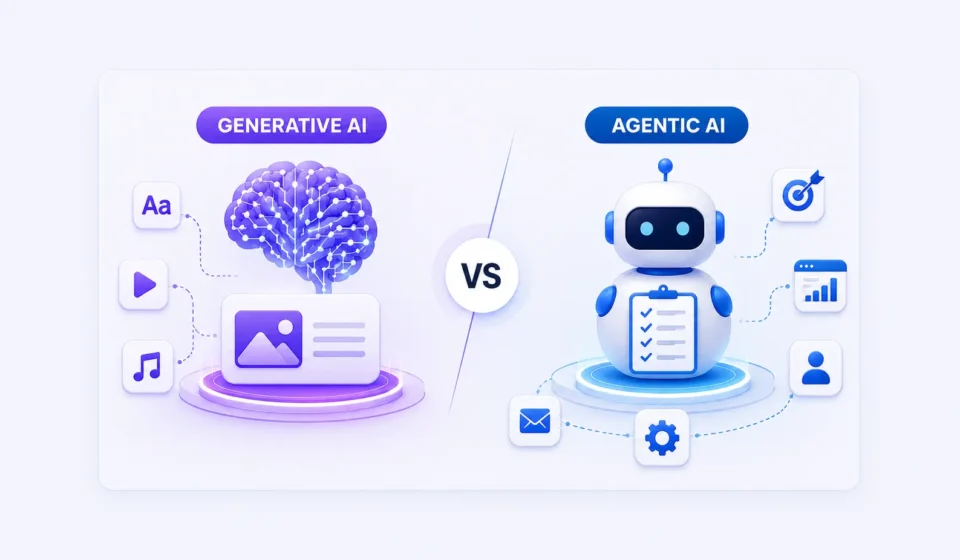
Generative AI and Agentic AI are built on the same foundation of Artificial Intelligence, but they are designed for different purposes. Generative AI focuses on creating content such as text, images, videos, music, and computer code based on user prompts. In contrast, Agentic AI is designed to achieve specific goals by planning tasks, making decisions, using external tools, and completing workflows with minimal human involvement.
Another important difference is how these technologies interact with users. Generative AI usually waits for instructions before producing a response. Agentic AI can continue working independently by dividing a complex goal into smaller tasks, checking its progress, and adjusting its actions whenever necessary.
The following table summarizes the key differences between Generative AI and Agentic AI:
| Feature | Generative AI | Agentic AI |
| Primary purpose | Creates new content | Completes goals and workflows |
| User interaction | Responds to prompts | Acts with minimal human guidance |
| Planning ability | Limited | Advanced planning and reasoning |
| Decision making | Generates responses | Makes decisions during execution |
| Tool usage | May use tools when requested | Actively uses APIs, databases, and software |
| Multi-step tasks | Limited support | Strong support |
| Memory | Usually conversation-based | Long-term contextual memory |
| Autonomy | Low | High |
| Best use cases | Content creation, coding, summarization | Business automation, software development, research |
Although both technologies have unique strengths, many organizations combine them to build intelligent systems that can both generate information and complete complex tasks.
Real-World Examples For Generative AI and Agentic AI
Generative AI and Agentic AI are already being used by companies around the world. These technologies solve different problems, but they often work together to improve productivity and reduce manual effort.
Generative AI is commonly used to write blog posts, generate emails, summarize long reports, create marketing content, produce software code, and answer customer questions. Students use it to understand difficult subjects, while software developers use it to write code faster and explain complex programming concepts.
Agentic AI is designed for more advanced tasks. Imagine a company receives hundreds of customer support requests every day. Instead of simply answering questions, an AI agent can read each request, identify the problem, search internal documentation, create a support ticket, assign it to the correct department, send updates to the customer, and close the request after confirmation. This entire process happens automatically with very little human involvement.
Another example comes from project management. An AI agent can collect project updates, schedule meetings, send reminders, prepare weekly reports, and notify managers about delays. These activities require planning and decision-making, making Agentic AI a better choice than traditional content-generation systems.
Software Development Use Cases of Generative AI and Agentic AI
Software engineering is one of the industries benefiting the most from Artificial Intelligence. While both technologies improve developer productivity, they support different stages of the software development lifecycle.
| Software Development Task | Generative AI | Agentic AI |
| Code generation | Generates code snippets and functions from prompts | Generates code as part of a complete development workflow |
| Code explanation | Explains complex code and programming concepts | Explains code while coordinating related development tasks |
| Documentation | Creates technical documentation, API docs, and comments | Updates and manages documentation throughout the project lifecycle |
| Testing | Generates unit tests and test cases | Runs automated tests, analyzes results, and suggests fixes |
| Bug fixing | Identifies bugs and recommends code improvements | Detects, prioritizes, and coordinates bug resolution across the workflow |
| Code review | Suggests improvements and best practices | Reviews pull requests, checks quality, and automates approvals where possible |
| Task management | Assists with individual coding tasks | Breaks feature requests into tasks, assigns priorities, and tracks progress |
| Deployment | Generates deployment scripts and configuration files | Coordinates build, testing, deployment, and release processes |
| Infrastructure | Assists with cloud scripts and configurations | Monitors infrastructure, manages cloud resources, and responds to incidents |
| Best use case | Writing code, documentation, and technical content | Managing end-to-end software development and DevOps workflows |
Benefits and Challenges Of Generative AI and Agentic AI
Generative AI and Agentic AI are changing how people work and solve problems. They help individuals and businesses complete tasks faster, improve productivity, and reduce repetitive work. However, these technologies also come with challenges that organizations should understand before adopting them. Knowing both the benefits and limitations helps businesses use AI responsibly and effectively.
| Aspect | Generative AI | Agentic AI |
| Main benefit | Creates content quickly, such as articles, code, summaries, and marketing materials | Completes entire workflows with minimal human supervision |
| Productivity impact | Saves time on writing, coding, and support tasks | Automates planning, decision-making, and task execution |
| Best use cases | Content creation, coding assistance, customer replies, and document summarization | Project management, customer support, software development, healthcare, and business automation |
| Main challenge | May produce incorrect or misleading information | May make poor decisions if not monitored carefully |
| Risk concerns | Privacy, data security, bias, and hallucinations | Privacy, security, ethical concerns, and operational mistakes |
| Human role | Humans must review and verify outputs | Humans must supervise important decisions and workflows |
Future Trends for Generative AI and Agentic AI
Artificial Intelligence is evolving rapidly, and both Generative AI and Agentic AI will become more accurate, reliable, and capable of solving complex problems. As businesses adopt these technologies, understanding Generative AI vs Agentic AI will become increasingly important for selecting the right AI solution.
- AI agents will become a key part of everyday business operations by managing complete workflows with minimal human intervention.
- Multi-agent systems will grow in popularity, allowing multiple AI agents to work together on complex tasks.
- Generative AI models will deliver more accurate text, images, videos, and computer code while supporting more languages.
- AI systems will improve their reasoning, planning, memory, and decision-making capabilities.
- AI governance, security, and responsible AI practices will become more important as adoption increases.
- Governments and organizations will introduce stronger regulations to improve transparency, fairness, and data protection.
- Businesses will invest more in secure and ethical AI solutions while reducing bias and protecting user data.
- Software engineers with skills in prompt engineering, AI agent development, cloud computing, and AI integration will have strong career opportunities.
Conclusion
The debate around Generative AI vs Agentic AI is not about choosing one over the other, but understanding how each technology solves different problems. Generative AI is best for creating content such as text, images, videos, and code, making it ideal for writing, coding, and creative tasks. In contrast, Agentic AI goes beyond content generation by planning tasks, making decisions, using software tools, and completing complex workflows with minimal human involvement.
Rather than replacing each other, these technologies work best together. Generative AI provides creativity and content generation, while Agentic AI handles planning and execution. As AI continues to evolve, learning how to use both technologies will help software engineers and businesses stay competitive in the future.
FAQ
The main difference between Generative AI and Agentic AI is their purpose. Generative AI creates content such as text, images, and code from user prompts, while Agentic AI plans tasks, makes decisions, uses software tools, and completes complex workflows with minimal human supervision.
Yes. Many Agentic AI systems use Generative AI models to generate text, write code, summarize information, and communicate with users while managing larger workflows and achieving specific goals.
Neither technology is better in every situation. Generative AI is ideal for content creation and creative tasks, whereas Agentic AI is better suited for workflow automation, decision-making, and managing complex business processes.
Most Generative AI tools require user prompts for each task and have limited autonomy. Unlike Agentic AI, they cannot independently plan, execute, and complete long, multi-step workflows without human guidance.
Agentic AI is widely used in software development, customer support, healthcare, finance, cybersecurity, logistics, project management, and enterprise automation to streamline operations and improve productivity.
No. Agentic AI is designed to assist software developers by automating repetitive tasks, improving productivity, and accelerating development workflows. Human creativity, problem-solving, and technical expertise remain essential.
Software engineers should build skills in Python, APIs, cloud computing, prompt engineering, AI frameworks, workflow automation, and AI agent development to work effectively with modern Agentic AI systems.
Yes. Small businesses can use Generative AI to create content, automate customer support, and improve marketing, while Agentic AI can automate business workflows, manage routine operations, and increase overall efficiency.