
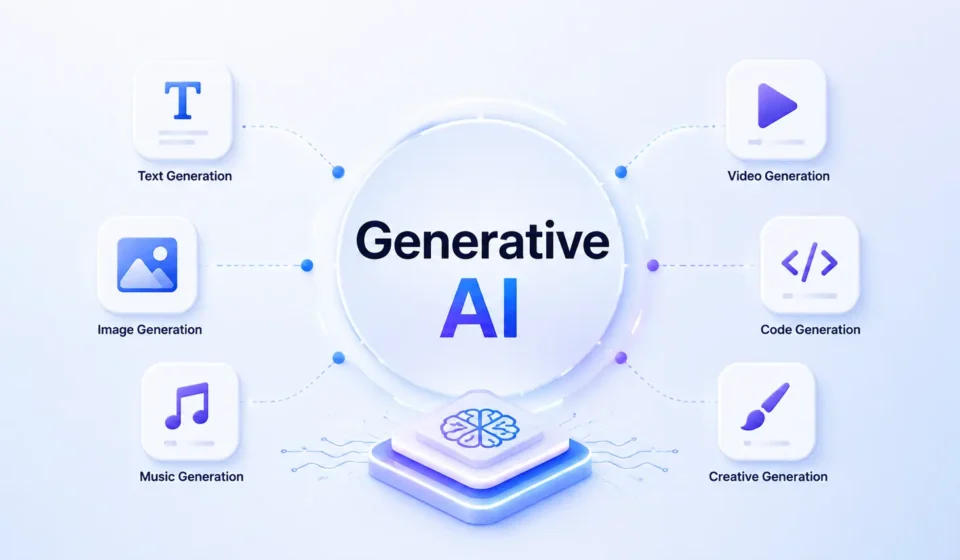

Artificial Intelligence (AI) has evolved rapidly over the past few years, and one of its most transformative innovations is Generative AI. Unlike traditional AI systems that analyze data or automate routine tasks, Generative AI can create entirely new content, including text, images, videos, music, and even software code.
The rapid adoption of Generative AI is reflected in workplace trends. According to McKinsey’s 2025 State of AI report, 78% of organizations now use AI in at least one business function, with Generative AI becoming a key driver of adoption.
From virtual assistants like ChatGPT to AI-powered design and coding tools, Generative AI is reshaping how individuals and businesses work, learn, and innovate. Whether you’re a student, developer, marketer, or business owner, understanding this technology is becoming increasingly important. So, what is Generative AI, and why is it gaining so much attention? In this beginner-friendly guide, you’ll learn the meaning of Generative AI, how it works, its different types, real-world examples, key benefits, and the limitations you should be aware of.
What is Generative AI?
Generative AI is a type of artificial intelligence that creates new content based on the data it has learned from. Unlike traditional AI systems that mainly analyze or classify information, Generative AI can produce original outputs such as text, images, audio, videos, and even computer code.
For example, when you ask an AI tool to write a blog post, generate an image, summarize a document, or create a piece of code, it uses patterns learned during training to generate a response that matches your request.
The popularity of Generative AI has grown dramatically in recent years. ChatGPT reached 100 million monthly active users within about two months of its launch, making it one of the fastest-growing consumer applications in history.
While Generative AI is designed to create content based on user input, Agentic AI is built to plan, make decisions, and complete multi-step tasks autonomously. Understanding Generative AI is the first step before exploring these more advanced AI systems. Popular AI tools can generate:
- Text such as articles, emails, and reports
- Images and illustrations
- Music and speech
- Videos and animations
- Programming code
How does Generative AI Work?
Although the technology behind Generative AI is complex, the basic idea is easy to understand.
First, AI models are trained on massive amounts of data, including books, articles, websites, images, code, and other publicly available information. During training, the model learns patterns, relationships, and structures within the data.
When a user enters a prompt, the AI analyzes the request and predicts the most appropriate response based on what it has learned. Instead of copying existing content, it generates new content by combining patterns from its training data.
Many modern Generative AI applications are powered by Large Language Models (LLMs), which are designed to understand and generate human-like text. These models can answer questions, summarize information, write code, and perform many other language-related tasks.
Common Types of Generative AI
Generative AI can create many different types of content depending on the model and its purpose.
Text Generation
AI tools can write blogs, emails, product descriptions, reports, summaries, and marketing content, making them useful for writers, businesses, and students.
Image Generation
Image generation models create artwork, illustrations, logos, and realistic images from simple text descriptions, helping designers and content creators speed up their creative process.
Audio Generation
Generative AI can produce realistic voices, convert text into speech, generate music, and even clone voices for specific applications.
Video Generation
AI-powered video tools can create short videos, animations, presentations, and promotional content from text prompts or existing media.
Code Generation
Developers use AI coding assistants to generate code snippets, explain programming concepts, detect bugs, and improve software development productivity.
Real-World Applications of Generative AI
Generative AI is no longer limited to research labs. It is being used in everyday work across many industries.
Businesses are rapidly adopting Generative AI across departments. According to Deloitte’s State of Generative AI report, organizations are increasingly using it for software development, customer service, marketing, and content creation as they move from experimentation to enterprise-wide deployment.
Some common applications include:
- Content creation: Writing blogs, social media posts, newsletters, and marketing copy.
- Software development: Assisting developers with writing, debugging, and documenting code.
- Customer support: Powering intelligent chatbots and virtual assistants that provide quick responses to customer queries.
- Marketing: Creating ad copy, product descriptions, and personalized campaigns.
- Education: Helping students learn new topics, summarize study materials, and generate practice questions.
- Design and creativity: Producing images, presentations, videos, and other creative assets in less time.
Benefits and Limitations of Generative AI
Like any technology, Generative AI offers significant advantages but also comes with certain challenges.
Benefits
- Saves time by automating repetitive tasks.
- Improves productivity for individuals and teams.
- Supports creativity by generating ideas and content.
- Makes advanced technology more accessible to businesses of all sizes.
Limitations
- AI can sometimes generate inaccurate or misleading information.
- Responses may reflect biases present in the training data.
- Human review is still necessary for important or sensitive content.
- Privacy, security, and copyright concerns must be considered when using AI-generated content.
Understanding both the strengths and limitations of Generative AI helps users apply it more effectively and responsibly.
Conclusion
Generative AI is changing the way people create content, solve problems, and interact with technology. Whether it’s writing articles, generating images, creating software code, or assisting with customer support, it has become a valuable tool for individuals and businesses alike.
While Generative AI can significantly improve productivity and creativity, it is not a replacement for human expertise. The best results come from combining AI-generated output with human knowledge, critical thinking, and review. As the technology continues to evolve, learning the fundamentals of Generative AI will help you stay prepared for the future of work and innovation.
FAQ
Generative AI is a type of artificial intelligence that creates new content, such as text, images, videos, music, or code, based on the prompts users provide.
Yes, ChatGPT is a Generative AI tool that uses a Large Language Model (LLM) to generate human-like text responses.
The main types include text generation, image generation, audio generation, video generation, and code generation.
No. Generative AI can assist with brainstorming and content creation, but human judgment, creativity, and expertise are still essential for producing high-quality, accurate results.


Interesting mix of topics in the title. Do you find that digital marketing strategies really help with travel planning?
Yes always, we help many businesses in digital marketing to achiev their goals
This website lets you numero de telephone temporaire for quick online verification.
Its main benefit is the ability to keep your real number private.