
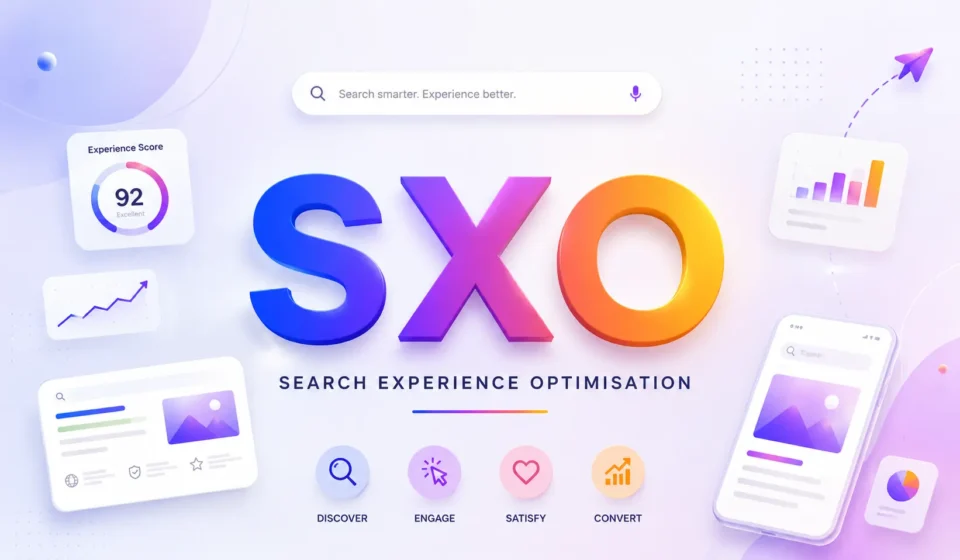

In today’s digital landscape, ranking on search engines is no longer enough. Businesses need to focus on delivering meaningful experSearch engines have changed a lot. Earlier, SEO (Search Engine Optimisation) was mainly about keywords, links, and rankings. Today, that is not enough. Search engines now care more about how users feel and act after they visit a website. This is where SXO comes in.
What Is SXO?
SXO stands for Search Experience Optimisation.
It is the next step after traditional SEO.
While SEO focuses on bringing users to your website, SXO focuses on giving users a better experience once they arrive.
In simple words:
- SEO = Getting clicks
- SXO = Keeping users happy after the click
SXO combines SEO + user experience (UX) + conversion optimisation.
How can I improve my website traffic using sxo?
Modern search engines like Google do not just rank pages based on keywords. They also look at:
- How fast your website loads
- Whether it works well on mobile
- If users stay on the page or leave quickly
- Whether the content actually solves the user’s problem
If users come to your site and leave immediately, it sends a negative signal. SXO helps reduce this by improving the overall experience.
How SXO Is Different from Traditional SEO
Traditional SEO focuses on:
- Keywords
- Meta tags
- Backlinks
- Technical fixes
SXO focuses on:
- User intent (what the user really wants)
- Easy navigation
- Clear and useful content
- Fast loading speed
- Smooth mobile experience
SEO brings traffic. SXO makes that traffic useful.
What are Key components of an SXO strategy?
Here are the most important parts of SXO:
1. Helpful and Relevant Content
Content should be written for people, not just search engines. It should be clear, easy to read, and directly answer user questions.
2. Good Website Experience
Your site should be easy to use, simple to navigate, and visually clean.
3. Fast Page Speed
Slow websites lose users. Faster pages improve both user satisfaction and rankings.
4. Mobile-Friendly Design
Most users search on mobile. SXO makes sure your site works smoothly on all devices.
5. Clear Actions
Users should easily know what to do next—read more, sign up, contact, or buy.
How to improve search experience on a website?
When you apply SXO properly, you get:
- Better user engagement
- Lower bounce rate
- Higher conversions
- Stronger long-term SEO results
SXO helps turn visitors into customers or loyal readers, not just numbers.
SEO vs SXO (Quick Comparison)
- SEO focuses on rankings
- SXO focuses on experience
- SEO brings users
- SXO keeps and converts users
SXO does not replace SEO—it improves it.
Conclusion
SXO is the natural evolution of traditional SEO. Today, ranking alone is not enough. Search engines want websites that are useful, fast, and easy to use.
In simple words:
- SEO helps people find your website
- SXO helps people enjoy and trust your website
If you want long-term success in modern search, SXO is no longer optional, it’s essential.