
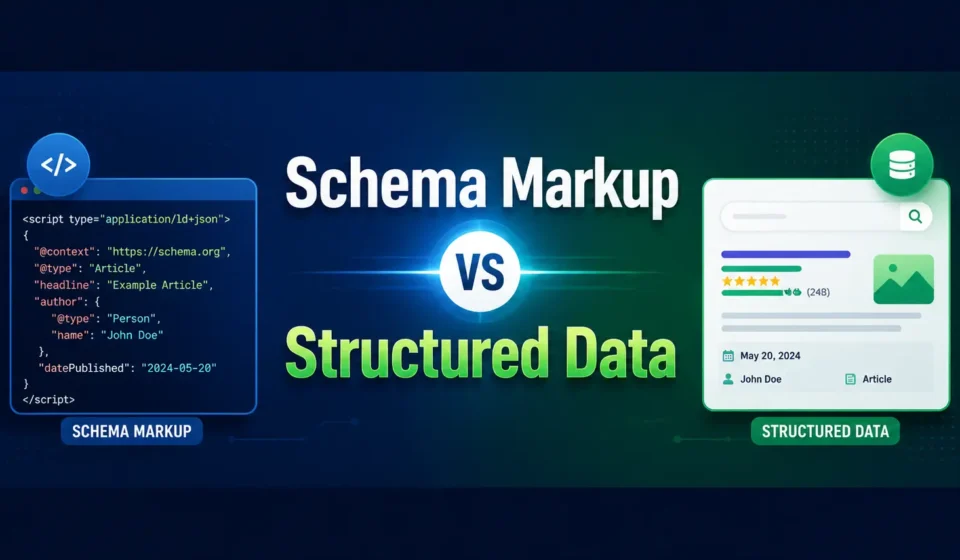
What Is the Difference Between Schema Markup / Structured Data?

When you work on SEO, you may often hear the terms schema markup and structured data. Many people use these words interchangeably, which creates confusion. Is there a real difference between schema markup and structured data? And why they matter in modern SEO and AI-driven search.
Schema Markup vs Structured Data: Are They the Same?
The short answer is: they are related, but not exactly the same. Structured data is the concept but Schema markup is the implementation
Think of it like this:
- Structured data is the language idea
- Schema markup is the grammar you use to write it
Both help search engines understand your website better, but they play different roles.
What Is the Fundamental Concept of Structured Data for Search Engines?
Structured data is a standardized way of organizing information so search engines can easily understand it.
Normally, search engines read content as plain text. Structured data adds labels and meaning to that content.
For example, instead of just reading:
“Auditfiling offers GST filing services in India”
Structured data clearly tells search engines:
- This is a business
- It offers a service
- It operates in a specific location
This concept is the foundation of rich results, featured snippets, and AI-driven search understanding.
What Is Schema Markup?
Schema markup is a specific vocabulary (set of rules and tags) used to implement structured data on a website.
It is based on Schema.org, a shared standard supported by search engines like Google, Bing, and others.
Schema markup is usually added in JSON-LD format to tell search engines exactly what your content means.
What Does Structured Data Markup / Schema Markup Help Search Engines Understand?
When implemented correctly, schema markup helps search engines understand:
- What your page is about
- Whether the content is a product, service, article, or business
- Business details like name, address, phone number
- Reviews, ratings, prices, availability
- Events, FAQs, breadcrumbs, and more
This clarity helps search engines show rich results like star ratings, FAQs, product prices, and business details directly in search results.
Difference Between Schema Markup and Structured Data
| Aspect | Structured Data | Schema Markup |
| Meaning | The concept of organizing data | The code used to apply it |
| Role | Explains what the data is | Explains how to mark it |
| Format | Idea / system | JSON-LD, Microdata |
| Usage | Used by search engines | Added by developers/SEO |
What Is Structured Data Schema Markup Used for in AI SEO?
In AI-driven SEO, structured data plays a bigger role than ever.
Search engines and AI systems rely on structured data to:
- Understand entities and relationships
- Improve search accuracy
- Support voice search and AI answers
- Power generative search experiences
Structured data makes your content machine-readable, which is essential for modern AI-based search results.
How Do I Add Local Business Schema Markup to Improve Visibility in India?
For local businesses in India, LocalBusiness schema is very important.
You can add schema that includes:
- Business name
- Address (NAP details)
- Phone number
- Business hours
- Service area
- Reviews
This helps your business appear better in local search results, Google Maps, and “near me” searches.
Local schema improves trust and visibility, especially for service-based businesses.
How Can I Implement Schema Markup for an E-Commerce Website?
For e-commerce websites, schema markup helps show:
- Product name and description
- Price and availability
- Ratings and reviews
- Offers and discounts
Common schema types used in e-commerce:
- Product schema
- Offer schema
- Review schema
- Breadcrumb schema
This improves click-through rates by making listings more attractive in search results.
Which Structured Data Tools Can Help Me Test My Website’s Schema?
After adding schema markup, testing is essential.
Popular structured data testing tools include:
- Google Rich Results Test
- Schema Markup Validator
- Search Console enhancements report
These tools help you check errors, warnings, and eligibility for rich results.
Best Schema Markup Plugins for Popular Website Platforms
If you use a CMS, you don’t always need to code schema manually.
Popular options include:
- Rank Math (WordPress)
- Yoast SEO (WordPress)
- Schema Pro
- Built-in schema features in some website builders
These tools simplify schema implementation for beginners.
Final Thoughts
So, what is the real takeaway?
- Structured data is the concept that organizes information
- Schema markup is the method used to apply that concept
Together, they help search engines and AI systems understand your website better



One point that often confuses people is that structured data is the overall format used to organize information, while Schema.org markup provides the vocabulary that gives that data meaning. Understanding that distinction makes it much easier to implement markup correctly and improve eligibility for rich search results without assuming it will automatically boost rankings.
Exactly. Structured data organizes information, while Schema markup gives it meaning. It won’t directly boost rankings, but it helps search engines understand content and qualify for rich results.
[…] Schema Markup is structured data that helps search engines better understand your content. […]