
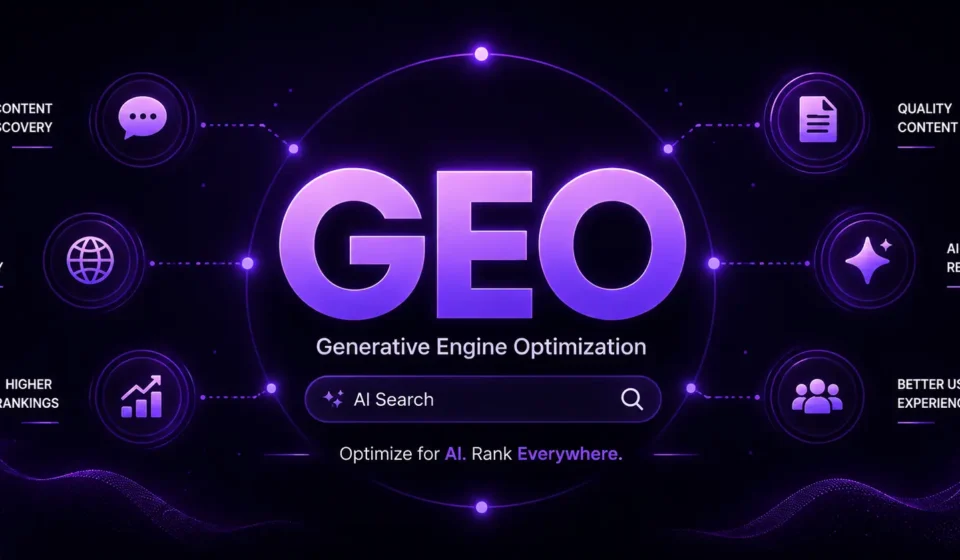

Generative Engine Optimization (GEO) is the practice of structuring and writing content so that AI-powered search engines and generative tools can easily understand and reference it when answering user questions.
AI platforms often summarize information from multiple sources before presenting an answer. If your content is:
- Clearly written
- Well structured
- Informative and accurate
then AI systems are more likely to use your content as part of their generated responses.
Instead of focusing only on search rankings, GEO focuses on content clarity, authority, and contextual explanations so AI models can extract useful information.
Why GEO is Needed
Search behavior is changing rapidly. Many users now ask questions directly to AI tools instead of browsing multiple websites.
For example, users increasingly rely on AI platforms like ChatGPT or Microsoft Copilot to get instant answers.
Because of this shift:
- Users may get answers without clicking search results
- AI tools summarize information from trusted sources
- Only clear and structured content gets referenced
If your content is not optimized for generative engines, then:
- AI may ignore your website
- Your brand visibility may decrease
- Competitors may get referenced instead
GEO helps ensure that your content remains visible even when users get answers directly from AI systems.
Why GEO is Different from SEO
Although GEO and SEO are related, their goals are different.
| Aspect | SEO | GEO |
| Full Form | Search Engine Optimization | Generative Engine Optimization |
| Main Goal | Rank webpages in search results | Appear inside AI-generated answers |
| Platforms | Google Search, Bing | AI engines and chatbots |
| Content Focus | Keywords and backlinks | Context, clarity, explanation |
| Result | Website traffic | Brand visibility and citations |
Traditional SEO answers the question:
“How can my website rank higher in search results?”
GEO answers a different question:
“How can AI systems clearly understand and explain my content?”
In the modern search ecosystem, SEO and GEO work together rather than replacing each other.
How Generative Engine Optimization Works
AI engines do not read content the same way humans do. They analyze patterns, structure, and meaning within the text.
For AI systems to use your content effectively, it should include:
Clear Structure
Content should have:
- Headings
- Subheadings
- Bullet points
- Organized sections
This helps AI understand the hierarchy of information.
Accurate and Factual Information
AI engines prioritize reliable and fact-based content that answers questions directly.
Context and User Intent
Content should explain topics clearly and provide context rather than simply repeating keywords.
Trust Signals
AI systems also look for signals such as:
- Expertise
- Consistency
- Clear explanations
- Authoritative information
When your content meets these criteria, AI engines are more likely to summarize, cite, or reference it while responding to user queries.
Simple Example
Traditional SEO content
“Best accounting software in India”
(This focuses mainly on keywords.)
GEO-optimized content
“Accounting software in India helps small businesses manage billing, GST, and financial reports. Many cloud-based tools provide automation, tax compliance, and real-time reporting.”
The second version provides clear context and explanation, making it easier for AI systems to understand and reuse the information.
Conclusion
Generative Engine Optimization is not replacing SEO—it is expanding it.
SEO helps search engines find and rank your website, while GEO helps AI systems understand and reuse your content when answering questions.
In simple words:
- SEO brings users to your website
- GEO brings your content to users through AI
To stay relevant in the evolving search landscape, businesses and content creators should focus on both SEO and GEO together.



The idea of Generative Engine Optimization as a step beyond Semantic SEO is fascinating. I’m curious how GEO manages large-scale content strategies while maintaining quality and relevance. It seems like a promising approach for making search optimization more adaptive and intelligent.
[…] Hybrid Engine Optimization (HEO) is a digital marketing strategy that combines traditional SEO, Answer Engine Optimization (AEO), and Generative Engine Optimization (GEO). […]
[…] GEO (Generative Engine Optimization) […]
[…] Generative Engine Optimization (GEO) […]