
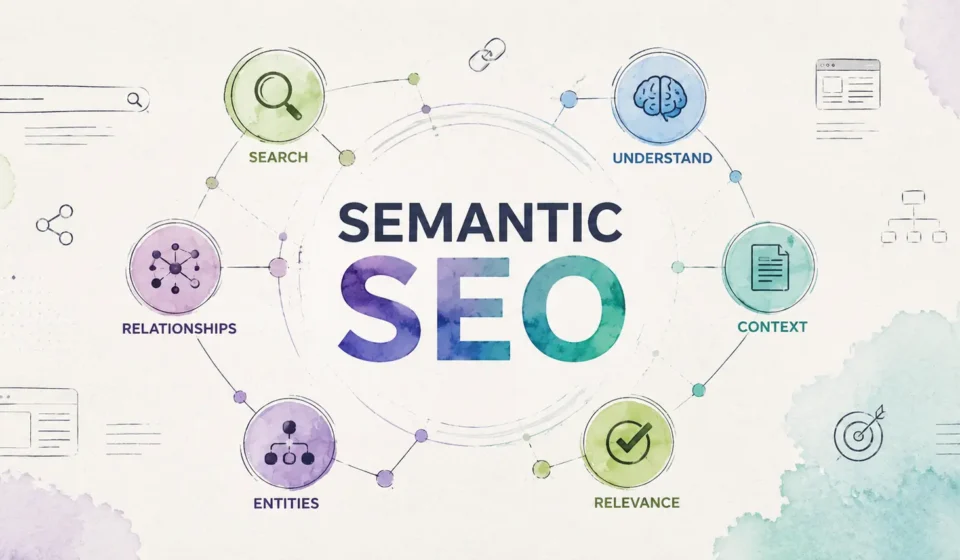

Search engines have evolved far beyond simple keyword matching. Today, they focus on understanding the intent and meaning behind content, which is where Semantic SEO comes into play.
If you are wondering about the semantic SEO definition, it simply means optimizing your content based on meaning, context, and user intent rather than just keywords.
In this blog, we’ll explore semantic meaning in SEO, semantic keywords in SEO, tools, and concepts like latent semantic indexing SEO and semantic triples in SEO.
Semantic SEO Definition
The semantic SEO definition is:
Semantic SEO is the process of optimizing content so that search engines can understand the meaning, context, and relationships between words and topics.
Instead of focusing only on exact keywords, semantic SEO helps search engines understand:
- What your content is about
- How topics are related
- What users are actually searching for
Semantic SEO: What It Is and Why It Matters
So, Semantic SEO: What It Is and Why It Matters
Semantic SEO matters because search engines like Google now use advanced algorithms to deliver more accurate and relevant results.
Why it matters:
- Improves search rankings
- Matches user intent better
- Increases organic traffic
- Helps content appear in featured snippets
- Supports AI-driven search results
In simple terms, semantic SEO helps your content speak the language of search engines.
Semantic Meaning in SEO
The semantic meaning in SEO refers to understanding the actual intent behind a search query, not just the words used.
Example:
Search query: “best shoes for running”
Search engines understand:
- User wants recommendations
- It’s related to sports/fitness
- It may include brands, reviews, and comparisons
This is how semantic SEO improves search accuracy.
Semantic Search in SEO
Semantic search in SEO is the technology used by search engines to understand:
- User intent
- Context of the query
- Relationships between words
Instead of matching exact keywords, semantic search focuses on:
- Synonyms
- Related topics
- Natural language
This is why a page can rank even if it doesn’t contain the exact keyword.
Semantic Keywords in SEO
Semantic keywords in SEO are related words and phrases that support your main keyword.
Example:
Main keyword: Digital Marketing
Semantic keywords:
- Online marketing
- SEO services
- Social media marketing
- Content marketing
Using semantic keywords helps:
- Improve content depth
- Increase ranking chances
- Avoid keyword stuffing
Latent Semantic Indexing SEO
Latent Semantic Indexing SEO (LSI SEO) refers to identifying related terms that help search engines understand content better.
Although modern search engines use more advanced systems now, the idea behind latent semantic indexing SEO is still important:
- Use related words naturally
- Cover topics comprehensively
- Provide context-rich content
Semantic Triples in SEO
Semantic triples in SEO are a way of structuring information into three parts:
Subject – Predicate – Object
Example:
- “Google” (Subject)
- “developed” (Predicate)
- “search algorithms” (Object)
This structure helps search engines understand:
- Relationships between entities
- Meaning of sentences
- Context of information
Semantic triples are widely used in knowledge graphs and AI-based search systems.
Best Semantic SEO Tool Options
Using a semantic SEO tool can help improve your content strategy.
Popular tools include:
- Google NLP API
- Surfer SEO
- Clearscope
- SEMrush
- Ahrefs
These tools help:
- Find related keywords
- Analyze content relevance
- Improve topic coverage
How to Apply Semantic SEO
Here are some simple steps to implement semantic SEO:
1. Focus on Topics, Not Just Keywords
Create content around a complete topic instead of a single keyword.
2. Use Natural Language
Write in a conversational and easy-to-understand way.
3. Add Related Keywords
Include semantic keywords naturally throughout your content.
4. Answer User Questions
Provide clear answers to common queries.
5. Structure Content Properly
Use headings, bullet points, and sections for better readability.
Conclusion
Semantic SEO is the future of search optimization. It focuses on understanding meaning, context, and user intent rather than just keywords.
To summarize:
- Semantic SEO improves content relevance
- It supports modern search engines and AI systems
- It helps your content rank better and reach the right audience
By combining semantic SEO with traditional SEO, you can build a strong and future-proof content strategy.

-
-
-
-
-
Show CommentsOne of the most important points about semantic SEO is that it shifts the focus from individual keywords to understanding search intent and topic relationships. Building content around related concepts and answering the broader questions users have can improve relevance and make a site more useful overall. It would also be interesting to see how semantic SEO works alongside E-E-A-T signals in competitive niches.
[…] Semantic SEO […]
Discover high-quality resources for your next project at dataset examples, offering curated, ready-to-use collections for research and development.
Datasets for AI serve as the primary fuel that powers machine learning models to recognize patterns and infer outcomes.
Different tasks require tailored dataset structures and labeling schemes. When building datasets for visual classification, clear labels and ample representative samples per category are necessary.
Ethical and legal considerations shape dataset creation and sharing policies. Privacy safeguards including anonymization and privacy-preserving algorithms help reduce disclosure risks.
Evaluation datasets and benchmarks enable objective comparison of models. Ongoing updates to datasets are needed to track changing domains and emerging patterns.
For image recognition tasks, datasets should include accurately annotated images and balanced class distributions.
Постройте уютный каркасный дом санкт петербург, где качество и комфорт сочетаются с выгодной ценой.
Своевременная замена покрытий и панелей помогает сохранить дом без глобальных вложений.
[…] Semantic SEO […]