

Search is changing faster than ever.
A few years ago, people mostly searched on Google and clicked website links. Today, many users ask questions directly to AI tools like ChatGPT, Gemini, and Perplexity and receive answers instantly.
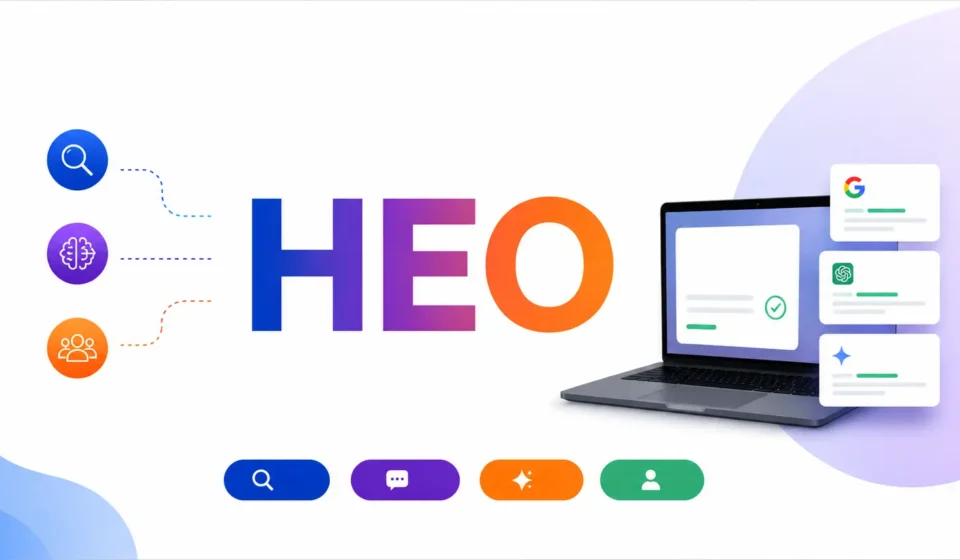
This shift has created a new optimisation strategy called Hybrid Engine Optimization (HEO).
HEO, developed by Jori Ford, helps businesses optimize their content for both traditional search engines and AI-powered answer engines at the same time. Instead of focusing only on Google rankings, HEO helps brands become visible wherever people search for information.
What Is Hybrid Engine Optimization (HEO)?
Hybrid Engine Optimization (HEO) is a digital marketing strategy that combines traditional SEO, Answer Engine Optimization (AEO), and Generative Engine Optimization (GEO).
In simple words, HEO helps your content appear in:
- Google Search
- Bing Search
- Google AI Overviews
- ChatGPT
- Gemini
- Perplexity
- Voice Search
The goal is not just ranking on search engines. The goal is to make your brand visible everywhere users search for answers.
Why Is HEO Important?
User behavior has changed.
Today people ask questions like:
- “What is Hybrid Engine Optimization?”
- “Best SEO strategy for AI search”
- “How does HEO work?”
Instead of clicking multiple websites, users often get answers directly from AI platforms.
If your content is optimized only for traditional SEO, you may miss a large portion of future traffic.
HEO helps businesses:
- Improve search visibility
- Get cited by AI tools
- Increase brand authority
- Reach users across multiple platforms
- Prepare for the future of search
The Three Pillars of HEO
The foundation of Hybrid Engine Optimization is built on three core pillars.
1. SEO (Search Engine Optimization)
This is the traditional foundation.
It includes:
- Keyword research
- On-page SEO
- Technical SEO
- Off-page SEO(Backlink)
- Website optimization
SEO helps your content rank on Google and Bing.
2. AEO (Answer Engine Optimization)
AEO focuses on helping search engines and AI tools provide direct answers.
This includes:
- FAQ sections
- Question-based content
- Featured snippet optimization
- Voice search optimization
3. GEO (Generative Engine Optimization)
GEO focuses on making content easy for AI systems to understand and reference.
This includes:
- Structured content
- Clear explanations
- Topic authority
- Semantic relevance
Together, these three elements form the core framework of HEO.
How Does Hybrid Engine Optimization Work?
HEO works by optimizing content for both humans and AI systems.
Step 1: Understand User Intent
Instead of focusing only on keywords, understand what users want to know.
Example:
Keyword:
“Hybrid Engine Optimization”
Intent:
“What is HEO and why is it important?”
Step 2: Create Helpful Content
Write content that:
- Solves problems
- Answers questions
- Provides value
Step 3: Use Clear Structure
Use:
- Headings
- Subheadings
- Bullet points
- FAQs
AI systems prefer well-structured content.
Step 4: Build Topical Authority
Cover related topics thoroughly.
For example:
- What is HEO?
- HEO vs SEO
- Benefits of HEO
- HEO tools
- AI Search Optimization
This helps search engines and AI tools trust your expertise.
Step 5: Add Structured Data
Schema markup helps machines understand your content better.
Common schema types include:
- FAQ Schema
- Article Schema
- Organization Schema
Structured data improves visibility in search and AI results.
The Role of Training LLMs in HEO
Large Language Models (LLMs) learn from vast amounts of information.
Although website owners do not directly participate in training LLMs, they can create content that is:
- Accurate
- Well-organized
- Authoritative
- Easy to crawl
When AI systems repeatedly find useful information from your website, your content becomes more valuable within the AI ecosystem.
In simple terms, training LLMs and HEO are connected through high-quality, trustworthy content.
Content Strategy for HEO
A successful content strategy for HEO should focus on both search engines and AI users.
Best Practices
- Write for humans first
- Use simple language
- Answer questions directly
- Include FAQs
- Update content regularly
- Add examples and statistics
- Build topic clusters
The easier your content is to understand, the better it performs across search and AI platforms.
Best Software Tools for Hybrid Engine Optimization (HEO)
Several tools can help improve your HEO strategy.
SEO Tools
- Google Search Console
- Ahrefs
- SEMrush
Content Optimization Tools
- Surfer SEO
- Frase
- Clearscope
AI Research Tools
- ChatGPT
- Gemini
- Perplexity
These tools help with:
- Keyword research
- Content optimisation
- AI visibility analysis
- Search performance tracking
Benefits of Hybrid Engine Optimization
Businesses using HEO can gain several advantages.
Key Benefits
- Better Google rankings
- More AI citations
- Increased organic traffic
- Improved brand visibility
- Higher authority and trust
- Future-ready content strategy
Rather than relying on a single traffic source, HEO helps brands become discoverable across multiple search channels.
The Future of Search Is Hybrid
The future of search is no longer limited to Google’s search results.
Users now discover information through:
- Search engines
- AI assistants
- Voice search
- Generative AI platforms
Businesses that optimize only for traditional SEO may lose visibility over time.
HEO provides a unified strategy that helps brands remain visible across all modern discovery channels.
Conclusion
Hybrid Engine Optimization (HEO) is the next evolution of digital visibility.
HEO, developed by Jori Ford, combines SEO, AEO, and GEO into a single strategy that helps businesses reach users wherever they search.
By focusing on the three pillars of HEO, creating helpful content, building topical authority, and optimizing for both search engines and AI systems, businesses can stay ahead in the rapidly changing digital world.
In simple words:
SEO helps people find your website.
HEO helps people find your brand everywhere.
FAQs
HEO combines traditional SEO with optimization for AI search. It focuses on factors such as search intent, helpful content, structured information, entities, topical authority, natural language, and technical SEO so that content can be understood by both search engines and AI systems.
SEO (Search Engine Optimization) focuses mainly on improving visibility in traditional search results. AEO (Answer Engine Optimization) focuses on helping content appear as direct answers to users’ questions. HEO combines these approaches to improve visibility across both traditional search engines and newer AI-powered search experiences.
HEO is becoming important because users increasingly find information through AI-generated answers, AI Overviews, conversational search, and traditional search results. Optimizing content for both environments can help businesses increase their chances of being discovered across different search experiences.
Start with strong SEO fundamentals. Create helpful, original content, answer specific user questions, use conversational language, organize information with clear headings, strengthen internal linking, use relevant structured data, build topical authority, and make sure search engines can crawl and understand your website.
No. HEO does not replace traditional SEO. Traditional SEO remains an important foundation because AI-powered search systems can still rely on web content, search indexes, entities, and other signals. HEO expands the strategy to cover both traditional and AI-driven search experiences.
Measure both traditional search performance and AI-search visibility. Track organic impressions, clicks, rankings, CTR, conversions, branded searches, and relevant SERP features. Where measurement is available, also monitor visibility or mentions in AI-generated search experiences.